

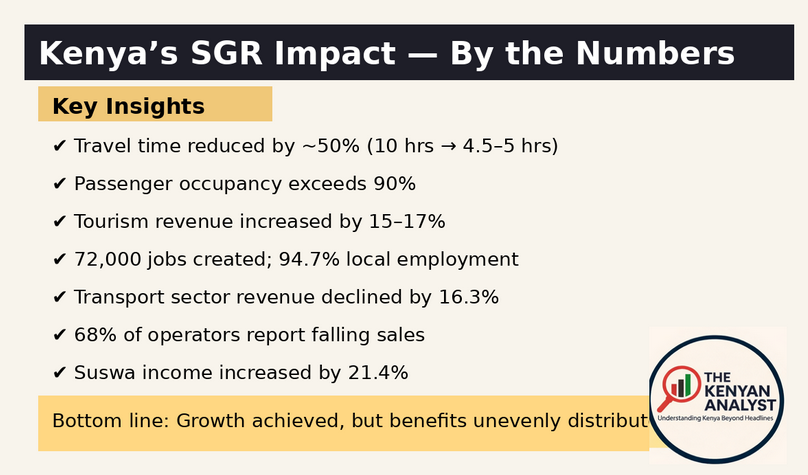
Kenya’s Standard Gauge Railway (SGR) was sold to the public as a game-changer. It was supposed to modernise transport, lower logistics costs, unlock trade, create jobs, and accelerate national development. In many respects, it has done exactly that. But that is only half the story. The harder question is whether the SGR has spread those gains fairly across Kenya—or whether it has concentrated benefits among those already better positioned to win. Based on the evidence, the answer is uncomfortable: the SGR has delivered growth, but not evenly, and in several important ways it appears to have deepened inequality rather than reduced it.
This matters because infrastructure is not just concrete, steel, and finance. According to Pierre-Richard Agénor’s theory of infrastructure-led development, major public investment can become an engine of long-term growth by reducing production costs, improving productivity, and stimulating private capital accumulation. In the older “Big Push” tradition associated with Paul Rosenstein-Rodan, large-scale investment can help economies escape low-growth traps and move toward sustained development. That logic is compelling for a country like Kenya, where infrastructure gaps have long constrained competitiveness. But even these theories are not naïve. They insist that infrastructure works best when it is well-governed, efficiently allocated, and complemented by other systems that make it productive.
That is where the SGR debate becomes more serious. Transport infrastructure theory does support large-scale rail investment because better transport improves accessibility, lowers trade and production costs, creates spillover effects, supports job creation, and attracts private investment. Yet the same theories also warns that transport projects do not automatically generate broad-based development. Because transport infrastructure is a semi-public good, its success depends heavily on financing structures, sustainability, policy coordination, and whether the project can balance short-term cash flow pressures with long-term public benefits. In plain language, a railway can be economically impressive and socially disappointing at the same time.
The SGR is a textbook example of that contradiction.
According to Zhu, Mwangi, and Hu’s (2023) research article published in the Journal of International Development, the railway reduced passenger travel time between Nairobi and Mombasa from around 10 hours by road to just 4.5 to 5 hours by rail. Passenger occupancy rates exceeded 90%, which is a strong sign that demand exists and the railway has improved connectivity in practical terms. Official expectations projected that the SGR could raise Kenya’s GDP by 1.5% annually. Among 132 stakeholders surveyed in their study, socio-economic outcomes clearly dominated perceptions of value: trade scored 4.58 out of 5, connectivity 4.57, cross-country economic integration 4.48, and employment 4.29. In the prioritisation exercise, 80.3% selected trade, 71.2% connectivity, 64.4% cross-country economic integration, and 59.1% employment as the most important impact areas. These are not minor results. They show that the railway has achieved the visibility and functionality expected of a flagship transport corridor.
There are also tangible sectoral gains, according to the same research article, and tourism-linked businesses benefited strongly. All the surveyed tour operators reported increases in goods and services sold and purchased. Passengers and tour operators reported average monthly revenue gains of 17.1% and 15.0%, respectively. Suswa recorded some of the largest local gains, with monthly revenue rising by 25.7% and household income by 21.4%. CRBC also reported that the SGR created 72,000 jobs in Kenya, including 39,000 managerial and technical positions, with a local employment rate of 94.73%. Afristar reportedly hired more than 3,000 local staff, with local staffing above 80%. Those numbers are significant, and they should not be dismissed.
But growth statistics do not automatically add up to inclusive development. Reports and studies like that of Zhu, Mwangi, and Hu have revealed that SGR has produced very uneven outcomes across sectors, towns, and business sizes. The road transport sector was hit particularly hard.
This is where the question of inequality becomes unavoidable. According to the article published in The Conversation, the socio-economic effectiveness of the SGR appears limited and highly uneven because its benefits have largely accrued to groups that already had stronger access to land, capital, or urban economic opportunity. The railway improved mobility for urban middle-class travellers between Nairobi and Mombasa and stimulated investment in central Kenyan towns such as Maai Mahiu and Suswa, where land values reportedly rose threefold after 2016. But that same dynamic also produced exclusion. Land acquisition for the first phase involved more than 4,500 hectares and about 29 million US dollars in compensation, yet large landowners benefited disproportionately while smallholders and squatters without formal land titles were displaced without compensation. Rural communities often experienced the railway not as liberation but as disruption. It blocked access routes, split family land and villages, and was often less useful than flexible buses and minibuses for everyday local movement.
Regional inequality also appears to have worsened. Mombasa, historically one of Kenya’s main commercial centres, reportedly lost business as customs clearing and related cargo functions shifted toward the Nairobi inland depot. That means one region’s infrastructure gain became another region’s economic loss. So while the SGR may have improved the national logistics map on paper, it also restructured opportunity in ways that favoured some corridors and weakened others. This pattern is not unique to Kenya. Africa’s mega infrastructure are effective at promoting economic growth but often much weaker at delivering inclusive development.
Even the World Bank’s The Impact of Infrastructure on Development Outcomes 2023 report notes that infrastructure is generally highly effective in low- and middle-income countries. But the same report stresses that effects vary by sector, by context, and by time horizon. Transport can generate major gains, yes—but those gains are often slower, less evenly distributed, and more dependent on complementary systems.
Such evidence should shape how Kenya thinks about the future, especially the Naivasha–Malaba extension. The relaunched project is valued at more than Ksh.500 billion and covers more than 350 kilometres in two sections: 264 kilometres from Naivasha to Kisumu and 107 kilometres from Kisumu to Malaba. Each passenger train is designed to carry 1,096 people at 120 kilometres per hour, while each freight train can haul 4,000 tonnes at 80 kilometres per hour, with annual freight capacity projected at 22 million tonnes. Those figures indicate huge strategic ambition. But ambition alone is not policy success. If the financing model is weak, the trade volumes insufficient, or the social costs poorly managed, the extension could reproduce the same inequalities on a larger scale, as the first phase of SGR.
The best model for major infrastructure in developing countries, according to the World Bank, is not pure sovereign borrowing and not full privatisation, but a blended risk-sharing model that combines public, private, and multilateral finance. Instruments such as partial credit guarantees, partial risk guarantees, political risk insurance, and export credit guarantees can lower borrowing costs and crowd in private capital. Lu and Wilson’s analysis from 355 projects across 33 African countries, which was published in the Journal of International Financial Markets, Institutions and Money, reinforces this logic. Kenya should take that lesson seriously. Infrastructure should not just be built; it should be financed in a way that preserves sustainability and broadens access.
So, is the SGR leaving too many behind? On the evidence, yes—at least for now. The SGR has delivered faster travel, stronger tourism activity, real commercial gains, and notable employment creation. But it has also displaced weaker sectors, widened territorial inequality, rewarded those with land and capital, and left too many rural and informal livelihoods exposed.
Join the Discussion
Share your thoughts and engage with the community
Leave a Comment
Comments
No comments yet. Be the first to share your thoughts!